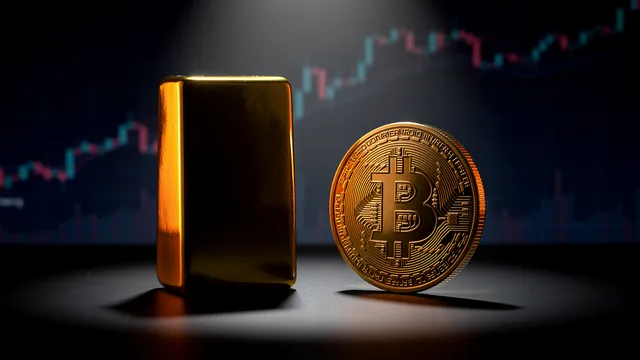
We put ten of the most common gold investment questions directly to the Investofil AI advisor. These are questions actual investors ask, not hypotheticals — and the answers are the AI’s real responses in 2026’s market context, not summaries or paraphrases.
At the end of each answer there’s a note on what to actually do with that information.
Q1: Is gold still a good investment in 2026?
Yes — more so than at almost any point in the last decade. Gold delivered roughly 64% in 2025, its best year in decades, and the structural drivers are still in place: central bank buying at 800+ tonnes annually, persistent geopolitical uncertainty, and real yields that remain relatively low.
The case for gold in 2026 isn’t about riding momentum. It’s about what gold does in a portfolio. As covered in Is Gold a Smart Investment in 2025? Key Pros & Cons, its primary value is in crisis scenarios and currency debasement — both of which are plausible in 2026. If you don’t hold any gold right now, that’s a gap worth thinking about.
What to do: figure out which form fits your situation — physical, ETF, or tokenized — before deciding how much to buy.
Q2: How much gold should I hold in my portfolio?
For most investors, 5–10% is a sensible starting range. Academic research on portfolio construction consistently shows that allocation improves risk-adjusted returns over time without seriously sacrificing upside. Above 15% you’re tilting heavily toward a single commodity, which creates a different concentration risk.
It varies by what you’re trying to do. Capital preservation investors are typically looking at 8–12%. Balanced portfolios carrying both growth and protection sit at 5–8%. More aggressive investors holding gold purely as a tail-risk hedge: 3–5%. If you’re heavily concentrated in crypto, the AI suggests 10–15% of that portfolio in gold or tokenized gold.
What to do: ask the AI advisor to look at your current holdings and give you a specific number rather than a range.
Q3: What is the best time to buy gold in 2026?
Trying to time gold’s entry is generally a losing game for long-term investors. The price drivers — geopolitical events, central bank decisions, real yield movements — don’t give reliable short-term signals. The cost of waiting for a better entry often turns out to be missing the rally entirely.
That said, gold does tend to perform better in specific conditions: falling real yields, a weakening dollar, geopolitical escalation. If those are present or building, you have a reasonably favorable context. Best Time to Buy Gold: Key Strategies for Smart Investors goes deeper on the specific signals worth watching.
The practical answer: if you’re underweight gold, buying at a reasonable allocation now beats waiting indefinitely for a correction that may not arrive.
What to do: set your target allocation first, then dollar-cost average into it over 3–6 months rather than going all in at once.
Q4: Is gold a better inflation hedge than crypto?
For inflation hedging specifically, gold has the stronger track record. During the 2021–2022 inflation spike, gold rose steadily. Bitcoin initially rallied but then crashed 75%+ while inflation kept running — which is a pretty direct refutation of the inflation hedge narrative, at least on that sample.
The mechanism behind gold is well understood: when real yields (nominal rates minus inflation) fall, holding gold gets cheaper relative to income-generating assets. That relationship is documented across decades. Bitcoin’s relationship with inflation is shorter and inconsistent.
The TIPS vs gold inflation hedge analysis covers when gold outperforms TIPS and when it doesn’t. Short version: gold handles macro uncertainty and crisis scenarios; TIPS give you more precise, mechanical inflation tracking.
What to do: if inflation protection is the goal, gold is more defensible than crypto. A TIPS plus gold combination is what many professional portfolios use.
Q5: Should I hold gold or Bitcoin — or both?
Both, if you can live with Bitcoin’s volatility. They do different things.
Gold is a crisis hedge — low volatility, zero counterparty risk, long track record. Bitcoin is a high-risk, high-reward technology bet with asymmetric upside potential. Their historical correlation in calm markets is low, which means they genuinely diversify each other rather than just doubling your exposure to the same theme.
A reasonable setup: gold as the foundation at 5–10% of the portfolio, Bitcoin as a satellite position at 1–5%. That lets you benefit from Bitcoin’s upside without leaning on it for downside protection — which it has failed to deliver during acute market stress more than once.
Full 2026 data breakdown: Gold vs Bitcoin 2026: What Our AI Advisor Recommends.
What to do: decide in advance what the maximum Bitcoin drawdown you can absorb looks like. Bitcoin has dropped 70%+ multiple times. Size the position so that outcome is painful but not catastrophic.
Q6: Is tokenized gold (PAXG) a good alternative to physical gold?
It’s a complement, not a substitute. PAXG gives you direct gold ownership — not a fund unit — with 24/7 liquidity, fractional amounts, and no storage logistics. Monthly third-party audits and US regulatory oversight make it the most defensible tokenized gold product available.
The trade-off is counterparty risk. Physical gold has none. PAXG depends on Paxos Trust Company functioning correctly. That risk is low, but it’s not zero, and that difference matters for a portion of any serious wealth preservation position.
For most investors the combination works best: physical gold as the core, PAXG as a liquid and DeFi-capable layer on top. Full comparison across all three major tokenized products: Tokenized Gold vs Physical Gold 2026.
What to do: if you already hold physical gold, PAXG adds liquidity and DeFi utility without replacing what you have. If you’re new to gold, starting with PAXG on Coinbase is accessible — but plan to add physical as your position grows.
Q7: Will gold reach $7,000 per ounce?
$7,000 by 2030 is within the credible analyst range, not an extreme forecast. Gold crossed $5,000 in 2025, and the structural demand trajectory from central banks hasn’t changed.
The gold price prediction to $7,000 by 2030 analysis covers what would need to hold: sustained central bank demand, continued dollar weakening, persistent geopolitical instability, and low real yields. All plausible, none guaranteed. AI model forecasts for end-2026 cluster around $5,350–$5,780.
What to do: don’t anchor to a specific price target. The more useful question is whether the structural case for holding gold remains valid — and currently it does.
Q8: How do I protect my gold from rehypothecation risk?
Rehypothecation is when your gold gets lent out or used as collateral by an intermediary without your knowledge. It’s a real risk in paper gold products — ETFs, futures, unallocated accounts. The only way to eliminate it fully is to hold allocated, segregated physical gold in your own name, either at home or in a non-bank private vault.
Understanding gold rehypothecation risks is worth reading before committing to any paper or digital gold product. Gold ETFs like GLD use sub-custodians and allow some gold lending, which creates counterparty chains. PAXG holds allocated, segregated bars with each token mapping to a specific bar number. Physical coins and bars you own outright have zero rehypothecation risk by definition.
What to do: check your current gold product’s prospectus or terms for “allocated” vs “unallocated” language and sub-custodian arrangements.
Q9: Is gold good for portfolio diversification in a crisis?
Gold is one of the most consistent crisis diversifiers available. In 2008 it rose 17% while the S&P 500 fell 37%. In March 2020 it dipped briefly alongside everything else before recovering to new highs within months. The historical data across multiple crises tells the same story repeatedly.
The mechanism: gold has near-zero equity correlation in normal markets and moves toward negative correlation during acute crises — precisely when you most need a hedge to not behave like everything else you own.
Bitcoin’s crisis correlation goes the other way. It moved with equities during the October 2025 tariff shock, with S&P 500 correlation reaching 0.86. Gold and Bitcoin cannot substitute for each other in this role.
What to do: if Bitcoin is your main protection against equity crashes, that assumption has been tested and failed under stress. Gold is the more reliable hedge for that specific purpose.
Q10: Should I sell gold now or hold through 2026?
For investors holding gold as a long-term hedge, the case for holding remains intact. Central bank demand, de-dollarisation, and geopolitical uncertainty haven’t reversed. AI model forecasts point to $5,350–$5,780 by year-end — still meaningful upside from current levels.
You’d have a case for reducing exposure if: real yields spike sharply (the Fed tightens while inflation drops), geopolitical tensions meaningfully de-escalate, or gold has appreciated to the point where it exceeds your target allocation. That last one deserves attention — if gold ran from 7% to 14% of your portfolio because of price gains, rebalancing back to target is sensible. It’s not the same as exiting.
Gold price predictions for 2025–2026 covers the technical and fundamental picture. Best times to buy and sell gold has the specific signals worth monitoring.
What to do: if gold is a core position, do nothing. If price appreciation has pushed it above your target weight, trim back to target rather than selling out entirely.
Using the advisor for your actual situation
These are the AI’s general-framework answers. They’re useful context, but they’re not personalised to what you own, what your timeline is, or what you’re actually trying to protect against.
The Investofil AI advisor takes those inputs. Instead of asking “should I hold gold in 2026?” you can ask “I have $50,000 in GLD and I’m wondering whether to move 30% to physical gold — does that make sense given I’m 12 years from retirement?” That’s the conversation that produces something actionable.
The questions above are a starting point. The value is in the follow-up.